"Why are my plant's leaves turning yellow?" is probably the most-searched plant care question there is.
And the honest answer is: it depends entirely on the pattern. Yellow leaves aren't one problem with one fix - they're a symptom that six or seven completely different causes can produce, and the wrong fix for the wrong cause can actually make things worse.
Water a plant that's already overwatered because you read "yellow leaves mean thirsty," and you can push it straight into root rot.
So before you do anything, look closely at which leaves are yellowing, where on the leaf the color change starts, and what texture it has. That pattern is most of the diagnosis.
Overwatering is the single most common cause of yellow leaves, and it's the first thing to rule out - check whether the soil has actually dried out before assuming anything else. If it has, and the plant is still yellowing, the next most likely causes are too little light, too much direct sun, underwatering, a nutrient deficiency, or just normal aging of an older leaf.
Six causes, and how to tell them apart
| Pattern you see | Likely cause |
|---|---|
| Lower leaves, soft or mushy, soil stays damp | Overwatering |
| Leaves crispy and dry, soil pulled from pot edges | Underwatering |
| Older leaves yellow one by one over weeks | Not enough light |
| Bleached patch facing the window, papery texture | Sunburn |
| Yellowing between green veins, new growth pale | Nutrient deficiency |
| One older leaf near the base, everything else fine | Normal aging |
A plant can have more than one of these at once - which is exactly why "just water it more" is bad universal advice.
Overwatering - The most common cause by far
Lower and inner leaves turn yellow first, sometimes with a slightly mushy or translucent feel. Soil stays damp for days after watering. In bad cases, you'll notice a musty smell or the stem feels soft near the base.
Let the soil actually dry out - check the top 2-3cm with a finger, not a calendar. Make sure the pot has drainage and isn't sitting in a saucer of water. If roots feel mushy or smell bad when you check, that's root rot, and the plant needs repotting into fresh, dry soil.
Underwatering - Less common, but easy to mistake for overwatering
Leaves turn yellow and go crispy or dry rather than soft, often starting at the edges and tips. Soil pulls away from the sides of the pot. The whole plant looks slightly wilted even right after you'd expect it to perk up.
Water thoroughly until it runs from the drainage holes, not just a splash on top. If soil has fully dried and hardened, it may be repelling water rather than absorbing it - try bottom-watering by sitting the pot in a tray of water for 20-30 minutes.
Not enough light - Slow, general yellowing across older leaves
Older, lower leaves yellow gradually and drop one at a time, even though watering seems fine. New growth (if there is any) comes in smaller, paler, or more widely spaced than older leaves.
The plant is shedding leaves it can no longer afford to keep, because it isn't getting enough light to power them. Move it closer to your brightest window, or check that nothing is casting more shade than it looks like - a lux reading tells you far more than "it's near a window" ever will.
Too much direct light - Sunburn, not a nutrient problem
Yellow or bleached patches appear specifically on the side of the plant facing the window, often with a papery or crispy texture at the center of the patch rather than at the leaf edge.
Move the plant back from unfiltered direct sun, or add a sheer curtain between it and the glass. This is especially common with plants moved outdoors for summer and then straight into a bright window - acclimate gradually instead.
Nutrient deficiency - Usually shows a pattern, not just a color
Yellowing between the veins while the veins themselves stay green (often a magnesium or iron issue), or uniform pale yellowing across new growth specifically. Common in plants that haven't been repotted or fed in over a year.
Feed with a balanced liquid fertiliser during the growing season, and check the plant hasn't outgrown its pot - after a year or two, most potting mixes are simply out of nutrients to give.
Normal aging - Sometimes it isn't a problem at all
A single older leaf near the base yellows and drops, while everything else on the plant looks healthy and new growth continues normally. Usually just one leaf at a time, not several at once.
Nothing to fix. Plants naturally shed their oldest leaves as they age and redirect energy to new growth - this is completely normal and not worth troubleshooting unless it's happening to multiple leaves at once or new growth also looks unhealthy.

Why this is so hard to diagnose from a search result
Every generic "why are my leaves yellow" article - including, honestly, most of what's written above - runs into the same wall: it can describe the six patterns, but it can't look at your plant, in your light, with your watering history, and tell you which one it actually is.
That gap is exactly why I built Planterra's Plant Doctor the way I did.
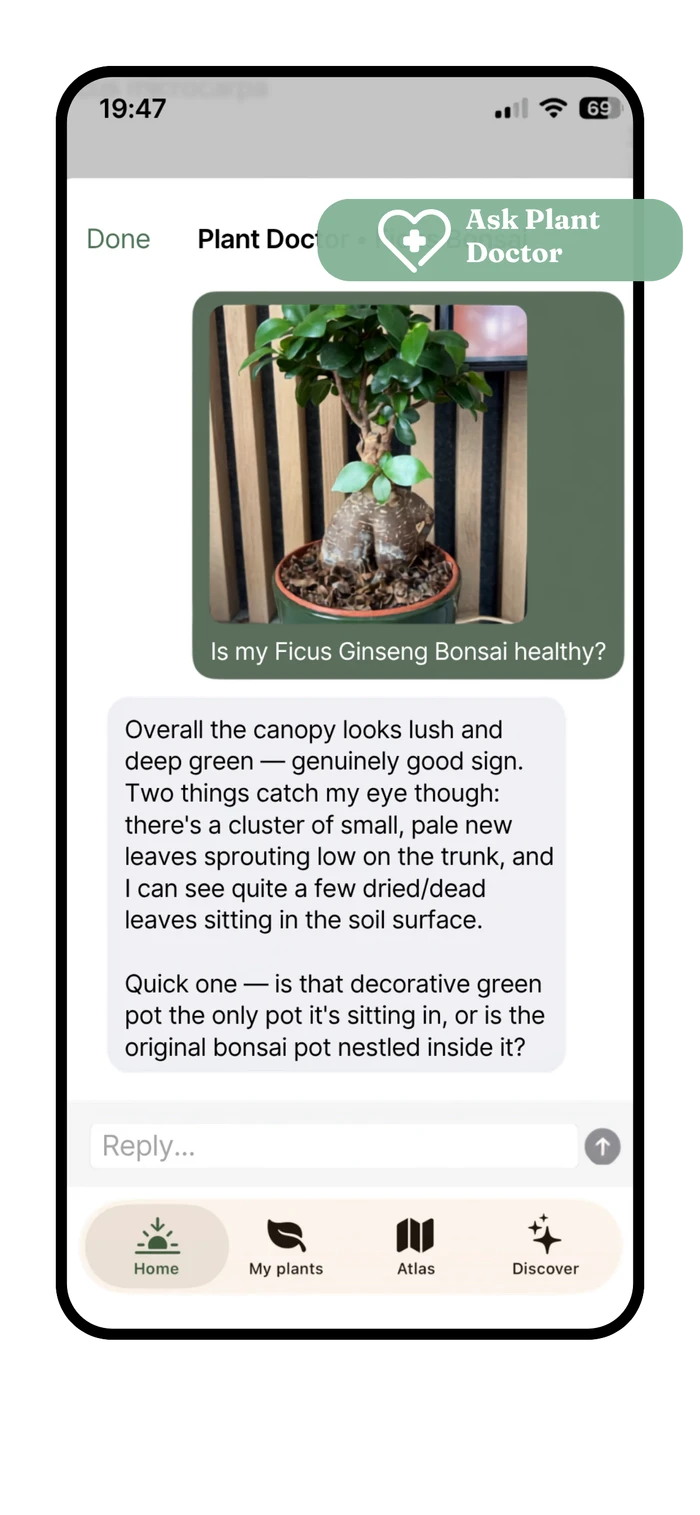
Send it a photo of the yellowing leaves, and it doesn't just pattern-match against a generic list like the one above. It already knows the plant's watering history, roughly how much light that specific spot has been getting, and what - if anything - changed recently. So instead of six possibilities, you usually get one or two real candidates, specific to that plant.
Is this yellow leaf normal aging, or the start of a problem?
That's the actual question underneath "why are my leaves turning yellow" - and it's not answerable from a photo alone. It needs context: what this plant's light has actually looked like, and whether this has happened before.
A single yellow leaf isn't a diagnosis. It's a data point.
The one habit that catches most of this early
You don't need to memorize six categories. You need to get in the habit of actually looking - which leaves, where on the leaf, what texture - instead of reflexively watering the moment you see yellow.
Check the soil before you check anything else. It rules in or out the single most common cause in about ten seconds, and it's the fastest way to avoid making an overwatered plant worse.
The leaf is the last thing to show a problem, not the first.
About this guide
This guide covers the most common causes of yellowing in typical indoor houseplants. Some species have specific quirks worth knowing separately - check the individual plant's entry in the plant directory for species-specific notes.
Disclosure
Planterra is my own app. The diagnostic patterns above apply regardless of what app or method you use to check them - the Plant Doctor section is about how Planterra specifically approaches the same problem.