There are a lot of plant care apps now.
Search for "best plant care app" and you'll find lists of apps promising to identify your Monstera, diagnose its yellow leaves, remind you to water it, and generally save you from your questionable plant-parenting decisions.
And honestly? A lot of them are pretty good.
But after looking through the current plant app landscape, one thing became clear: these apps don't all solve the same problem.
Some are essentially plant encyclopedias. Some are reminders with a beautiful interface. Some are excellent at identifying a plant from a photo. Some are designed to tell you what's wrong once your plant is already struggling.
And then there's a different question:
What if you don't need to know more about your plant - you need to know more about your home?
That's where things get interesting.
So here's an honest comparison of the best-known plant care apps in 2026, what each one does particularly well, where each one has limitations, and which type of plant parent each app is best suited for.
There isn't one universally "best" plant care app. Planta is a strong all-rounder, PictureThis is excellent for plant identification, Greg is particularly focused on care scheduling and community, PlantIn combines identification with care guidance, Blossom is useful for diagnosing visible problems, and Planterra takes a more holistic approach by looking at the individual plant, its history, and the specific environment it lives in.
The best plant care apps at a glance
| App | Best for | Main strength | Best suited to |
|---|---|---|---|
| Planta | All-around plant care | Care schedules, identification, diagnostics & plant info | Beginners and larger collections |
| PictureThis | Plant identification | Photo identification and plant information | Anyone who doesn't know what plant they have |
| Greg | Care reminders & community | Personalized schedules and social features | Plant parents who like reminders |
| PlantIn | Identification + basic care | Plant ID, care information and reminders | Beginners |
| Blossom | Plant problems | Photo-based diagnosis and care guidance | Plants that are already struggling |
| Planterra | Holistic plant care | Plant history, home environment, light analysis & ongoing consultation | Indoor plant parents who want personalized care |
The important thing is that these aren't necessarily competing head-to-head. They're answering different questions.
Planta - Best all-around plant care app
It's an excellent all-rounder - identification, care schedules, reminders, diagnostics, and a light meter all in one polished interface. If you're going to open an app every few days, good design matters more than people think.
Like almost every plant care app, the advice ultimately starts with the plant's species and general environmental information. Your “bright indirect light” corner might get two hours of direct afternoon sun the app has no way of knowing about.
Plant parents who want one polished app for identification, reminders, plant information and general care.
PictureThis - Best plant identification app
Identification is its superpower. Point your phone at a plant and get a fast, accurate species match plus reference information - genuinely useful when a nursery cutting shows up with no name attached.
Identifying a plant is only the beginning. Knowing it's a Monstera deliciosa tells you what the species generally prefers - it doesn't tell you whether the exact spot in your apartment is actually suitable.
Anyone who frequently asks "What plant is this?"
Greg - Best for reminders and plant community
It makes plant care feel manageable. Personalized schedules try to account for conditions rather than a flat "water every X days," and the community layer appeals to people who want more than a utility app.
A schedule is still a schedule. A plant beside a sunny window can dry out completely differently from the same species a few metres away - reminders help, but they’re not the final word.
Plant parents who enjoy reminders, structure and a community around their plants.
PlantIn - Best for beginners who want ID + care guidance
Identify the plant, learn about it, take care of it - a very reasonable starting point for someone just beginning to build a collection, without needing to already know what they’re looking for.
The same gap as most of the category: the difference between general plant knowledge and your plant's actual environment. A care guide can't tell you what your windowsill is really doing.
New plant parents who want identification and basic care guidance in one place.
Blossom - Best for diagnosing plant problems
It focuses squarely on the "what’s wrong with my plant?" moment - genuinely valuable, since plant problems are often hard to diagnose from a leaf photo and a Google search alone.
Diagnosis is inherently reactive. By the time a plant shows obvious symptoms, the underlying environmental problem may have been happening for days or weeks already.
Plant parents whose biggest question is "Why does my plant look like this?"

Planterra - Best for holistic plant care
Full disclosure: I built Planterra. So obviously, I'm not going to pretend this section is unbiased.
But I also didn't build Planterra because I thought the other plant apps were bad. Quite the opposite. While researching plant care apps, I kept finding apps that were really good at identifying plants, giving care advice, sending reminders and diagnosing problems. And I kept coming back to a bigger question:
What if a plant care app could actually get to know the individual plant?
That's the idea behind Planterra. Think of it less like a plant encyclopedia and more like a personal home plant doctor. A doctor doesn't just look at you once and give you generic advice based on your age. They look at your history. What happened before? What changed? What symptoms did you have last time? What is different now? Plant care can work the same way.
Planterra keeps the plant's history in mind
Your plant isn't a blank slate every time you open the app. Maybe it was moved three months ago. Maybe it was repotted. Maybe it had yellow leaves last winter. Maybe you changed its location because the previous spot was too dark. Those details matter.
Planterra's Plant Doctor is designed to act as an ongoing consultant that knows the plant's history and can use that context when helping you understand what's happening now - instead of treating every question as a completely new one.
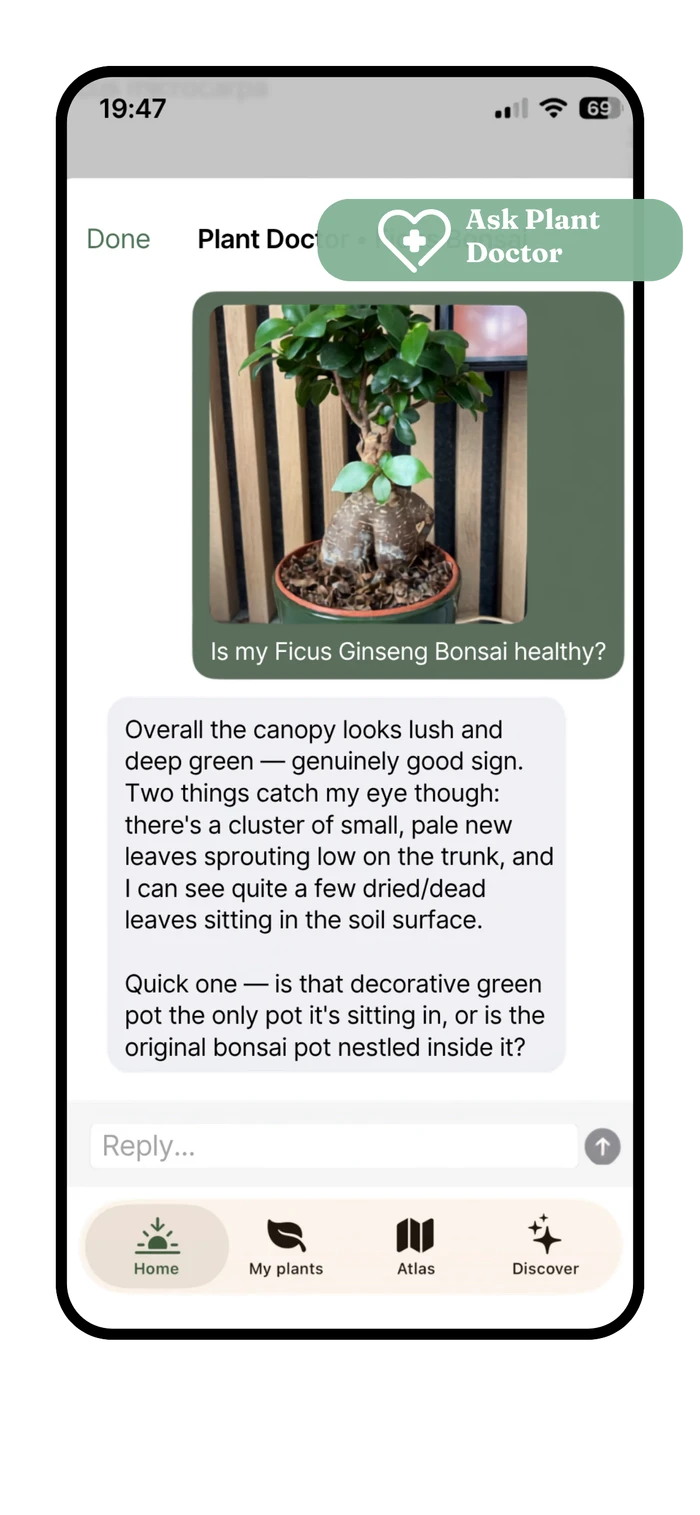
And then there's the environment
This is where Planterra's light analysis comes in. Knowing the plant's history is only half the story - the other half is knowing where it lives. Planterra can analyze light in your home using your phone's camera and track how sunlight moves through your space over the course of the day.
So instead of simply saying:
Your Monstera needs bright indirect light.
Planterra can help answer:
Is the spot where your Monstera actually lives giving it enough light?
And those are very different questions.
Planterra tries to connect all of those pieces - species, history, location, and changing light - into one picture.
The goal isn't more plant information
There is already an enormous amount of plant information online. The problem usually isn't "I can't find information about Monstera." It's:
I don't know what this information means for my Monstera, in my apartment, right now.
That's the gap Planterra is trying to fill. The idea is simple:
A plant shouldn't just have a care guide. It should have a care history.
Plant parents who want ongoing, personalized help rather than isolated reminders, identifications or diagnoses.
Especially if you find yourself asking:
- Is this plant actually happy here?
- Why is this plant struggling when my other one is fine?
- Should I move it? Did something change?
- What happened the last time this plant had this problem?
- Is the light in this spot good enough? What should I do next?
So… which plant care app is actually best?
Honestly? It depends on what you're trying to solve.
Want an all-around app?
Try Planta. Identification, schedules, diagnostics and plant info in one place.
Mainly want to identify plants?
Try PictureThis. Identification is where it really stands out.
Need help remembering care?
Try Greg. Reminders and a community around your plants.
New to plants?
Try PlantIn. Identification and care guidance, approachable for beginners.
Plant already looking unhealthy?
Try Blossom. Photo-based diagnosis to help you figure out what's wrong.
Want to understand your plant's specific conditions?
Try Planterra. The plant, its history, its environment, and its changing light - together.
Are plant care apps actually worth it?
Yes - but only if you know what you want one to do.
If you have three plants and already know exactly when they need water, you probably don't need to pay for a plant care app. If you have twenty plants, keep forgetting what you've watered, constantly buy plants without knowing where they'll go, or find yourself Googling every suspicious brown leaf, an app can be genuinely useful.
The trick is choosing one that solves your actual problem.
Don't download a reminder app because you think you need a light meter. Don't download an identification app because you need help understanding a sick plant. And don't assume that because an app knows the species of your plant, it automatically knows the conditions in your home.
Start with the question you're actually trying to answer.
About this comparison
This article was written in 2026 and focuses primarily on indoor plant-care apps and the problems they solve. Features, pricing and availability can change over time, so check each app's current App Store listing before subscribing.
Disclosure
Planterra is my own app, so naturally I'm biased when it comes to Planterra. The goal of this comparison isn't to declare one universal winner, but to explain where different plant care apps are genuinely useful - and where they differ.